
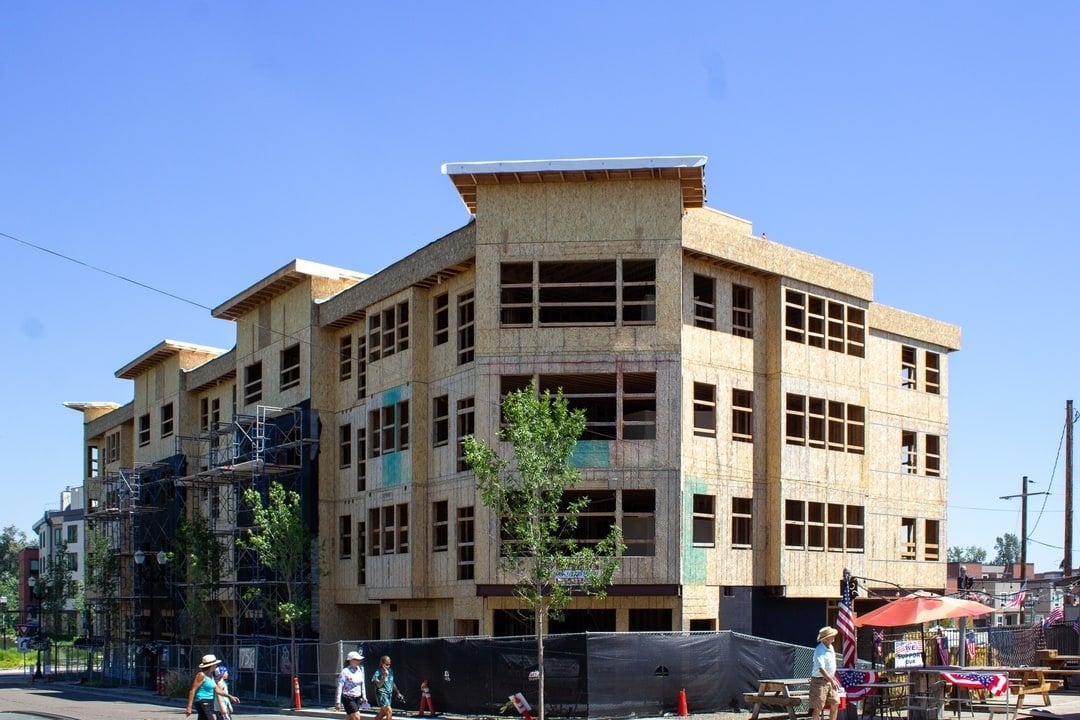
Wood framing is the standard for most multifamily and light commercial buildings because it is fast, light and widely understood by crews and inspectors. Light gauge steel is used where code requires noncombustible construction, such as Type I and II buildings, and in some interior and podium-level work. Many projects use both.
Two Systems, Different Jobs
Wood and light gauge (cold-formed) steel are not interchangeable on every building. The construction type the code assigns to a project often decides the framing system before anyone compares schedules.
Wood framing is permitted in Type III, IV and V construction. Light gauge steel is noncombustible, so it can be used in Type I and II buildings where wood structural framing is not allowed.
Where Wood Framing Fits
Wood remains the most common structural framing system for:
- Garden-style and mid-rise apartments, including 4-over-1 and 5-over-1 podium buildings
- Senior living, hotels and student housing
- Retail, restaurants and light commercial buildings
- Schools and civic buildings with wood-framed wings or additions
Where Light Gauge Steel Fits
Light gauge steel is typically specified for:
- Type I and II buildings that require noncombustible construction
- Interior partitions and soffits in commercial tenant improvements
- Curtain wall backup and exterior wall infill on concrete or steel structures
- Podium-level walls below a wood-framed residential structure
How They Compare on the Job
- Weight: wood framing is lighter for most residential-scale spans, which keeps foundation and podium loads down.
- Schedule: experienced wood framing crews move fast with panelized walls, engineered lumber and repeatable unit layouts.
- Field changes: wood is easier to modify on site when MEP routing or openings change.
- Moisture: wood needs moisture management during the wet season. Lumber should be dried in and moisture-checked before it is closed in. Steel does not absorb water but needs protection from corrosion.
- Thermal performance: steel studs conduct heat, so exterior steel walls usually need continuous exterior insulation to meet energy code.
- Fire: steel is noncombustible. Wood buildings rely on rated assemblies, fire-retardant-treated lumber where required, sprinklers and fireblocking.
The Northwest Factor: Rain
In Oregon and Washington, wet-season framing is a planning issue, not a reason to avoid wood. Sequencing roof dry-in early, protecting stored lumber and checking moisture content before insulation and drywall keep a wood-framed building on track through winter.
Working With KB Contracting
KB Contracting frames commercial, multifamily, school and civic buildings across Oregon and Washington. We review drawings early, flag framing conflicts before they reach the field and coordinate with the steel and concrete trades on mixed-system buildings.
FAQs
Can wood framing be used on commercial buildings?
Yes. Wood framing is permitted in Type III, IV and V construction, which covers a large share of apartments, hotels, retail and light commercial buildings. The building code sets limits on height, area and occupancy for each type.
When is light gauge steel required?
When a building must be Type I or II construction, structural framing has to be noncombustible, so wood is not allowed for those elements. Light gauge steel is also common for interior partitions in commercial spaces.
Is a wood-framed building safe in a fire?
Modern wood-framed buildings use fire-rated wall and floor assemblies, sprinklers, fireblocking and draftstopping, all inspected during construction. They are designed to meet the same life-safety requirements as other construction types allowed for that occupancy.
Talk to Our Estimating Team
Commercial, multifamily, school and civic framing across Oregon and Washington. See our Commercial Framing work.